• Unpredictable scope: Litigation, complex negotiations, or corporate crises can shift daily. Estimating a fixed fee is risky for both client and firm.
• Variable expertise: Some hours require senior lawyers, some juniors. Billable hours allow proper alignment between experience and price.
• Revenue stability: Firms rely on predictable revenue streams. Even with faster research tools or AI, lawyers generally work the same number of hours per day, maintaining income levels.
Technology can make lawyers faster, but it doesn’t eliminate the need for human judgment in complex cases. Legal research with tools like Westlaw might cut hours spent finding precedents, but it cannot replace strategy, negotiation, or court appearances.
Where Outcome-Based Pricing Works Best for Legal
Not all legal work is complex. Many routine tasks are highly predictable and can be priced by outcome or as a fixed fee.
Examples include:
• Routine entity formation: Incorporating an LLC or company involves standard documents and predictable steps.
• Conveyancing: Property transfers generally follow clear legal procedures.
• IP filings: Trademarks, patents, and registrations are largely formulaic.
• Standard contract review: Non-complex contracts can be checked with legal AI tools.
In these cases, outcome-based pricing benefits both parties: clients know costs upfront, and law firms are incentivized to complete work efficiently. Legal tech accelerates this process, enabling fixed-fee delivery without compromising quality.
How Legal Tech Influences Pricing Decisions
Technology doesn’t kill billable hours - it shifts how lawyers spend their time. Legal tech can:
• Automate document assembly and form filling.
• Conduct rapid legal research and due diligence.
• Highlight potential issues in contracts using AI review.
• Manage workflow and deadlines for complex matters.
These tools make predictable work faster and allow lawyers to focus on strategic tasks. For predictable work, tech enables fixed fees. For complex work, it allows lawyers to spend more time on high-value, billable activities rather than low-level tasks.
Hybrid Pricing Approach: Flexibility Is Key
The legal industry is increasingly moving toward hybrid models. Firms combine pricing approaches depending on task type:
• Predictable tasks: Fixed fee or subscription-based pricing.
• Unpredictable work: Billable hours or capped fees with hourly overage.
• Mixed matters: Hybrid structures where routine elements are fixed, and complex elements are hourly.
Hybrid approaches balance client expectations with firm revenue needs while leveraging technology to improve efficiency.
Mapping Legal Tasks to Pricing Models
A practical way to understand where billable hours or fixed fees fit is to map legal tasks on a spectrum of predictability:
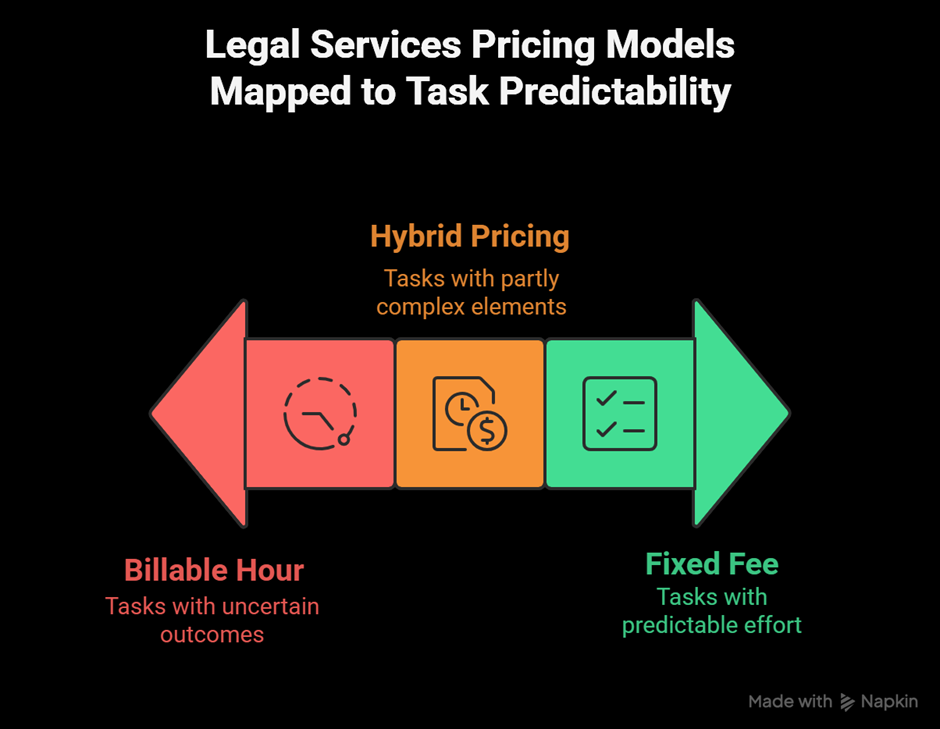
The table below clarifies the strategic role of legal tech: enhancing efficiency where possible and enabling flexible pricing structures. This framework makes it easier for firms to decide which pricing model suits each type of work. It also clarifies where technology has the most impact.
|
Legal Task / Service
|
Pricing Model
|
Reason
|
Tech Impact
|
|
Routine entity formation (LLC, Inc.)
|
Fixed fee
|
Standardized, low-risk
|
Document assembly, automation
|
|
Conveyancing / property transfers
|
Fixed fee
|
Standard legal steps
|
Process management software
|
|
IP filings (trademarks, patents)
|
Fixed fee
|
Predictable filings
|
E-filing platforms
|
|
Contract review (standard contracts)
|
Fixed / tiered
|
Low variability
|
AI review tools
|
|
Corporate compliance / regulatory filings
|
Fixed fee
|
Routine obligations
|
Compliance software
|
|
Litigation / court cases
|
Billable hours
|
Highly variable, outcome uncertain
|
Research AI, document automation
|
|
Complex negotiations / M&A
|
Billable / hybrid
|
Each deal unique
|
Workflow management tools
|
|
Internal investigations / crisis management
|
Billable hours
|
Scope unpredictable
|
Document analysis, AI assistance
|
|
Legal consulting / advisory
|
Billable hours
|
Advice depends on context
|
Knowledge management, workflow tools
|
The Client Perspective: Evaluating Legal Value
A common argument against fixed fees is that clients can’t judge a lawyer’s value. While it’s true that legal expertise is opaque, clients are capable of comparison. Multiple quotes, industry benchmarks, and transparent fee structures provide reference points.
• Experienced buyers: Corporations or repeat clients often understand what tasks cost and what outcomes are reasonable.
• Transparent offers: Fixed fees for standard tasks make costs clear and predictable.
• Blended models: Some firms offer a combination of fixed fees and hourly billing for unpredictable elements, allowing clients to manage risk.
Clients’ ability to compare doesn’t eliminate uncertainty - it simply reduces friction and builds trust. The perception of value isn’t absolute; it exists in the context of clarity, communication, and consistent results.
Anticipating Stakeholders’ Questions on Billable Hours
Forward-looking law firms should anticipate stakeholder inquiries and design services accordingly:
• Q: How does technology affect pricing?
A: Efficiency tools reduce routine tasks, which may shift billing from low-value to high-value activities.
• Q: When is hourly billing unavoidable?
A: Unpredictable cases, litigation, and bespoke advisory work still require flexible billing.
• Q: Is fixed-fee pricing risky for law firms?
A: Only if tasks are unpredictable. Using tech and experience to define scope mitigates risk.
• Q: Can hybrid models balance risk and transparency?
A: Yes, combining predictable fixed-fee work with hourly billing for variable elements works best.
Additional Questions for Law Firms to Consider
• Q: Will AI eliminate billable hours entirely?
A: No. AI reduces time on routine work but complex judgment remains human-led.
• Q: Which legal services are most suitable for fixed fees?
A: Standardized, repeatable tasks like filings, routine contracts, and compliance.
• Q: How do hybrid models work in practice?
A: Fixed fees cover predictable work; billable hours cover variable or complex tasks, with tech enabling clear tracking.
• Q: How does technology influence pricing strategy?
Why the Billable Hours Debate Persists
The argument over billable hours versus outcome-based pricing will continue because it touches core issues:
• Risk vs. reward: Firms must manage financial exposure on unpredictable matters.
• Client understanding: Clients vary in experience and willingness to pay for expertise.
• Tech adoption: Not all firms leverage technology equally, so efficiency gains vary.
• Cultural inertia: For many lawyers, the billable hour has been the standard for decades.
Understanding this context helps explain why predictions of the “end of billable hours” are often overstated. It’s not resistance to change - it’s an economic and practical reality.
Legal Pricing Isn’t One-Size-Fits-All
Billable hours are far from obsolete. They remain essential where work is complex, unpredictable, or high-risk. Outcome-based or fixed fees thrive where tasks are predictable, standardized, and tech-enabled. The future of legal pricing isn’t about replacing one model with another - it’s about understanding which approach fits which type of work.
By mapping legal tasks to pricing models and leveraging technology thoughtfully, law firms can satisfy client needs, protect revenue, and embrace efficiency without losing sight of the value they deliver.
For law firms exploring this balance, start with your routine work: identify what can move to fixed fees with tech support, and reserve billable hours for the unpredictable work that truly demands human expertise.