Please enjoy this ILTA Just-In-Time blog authored by @Catherine Casey, Chief Growth Officer, Reveal.

TechnoCat’s Primer on All Things [Legal] AI
Let's break down AI basics for the legal crowd without the Hollywood hype. Here’s the real deal on AI—ANI, ML, and NLP—what they mean for today's legal landscape.
Introduction: The AI Revolution
Welcome to the world of AI in legal, where artificial intelligence has evolved far beyond the realm of sci-fi and into everyday use. But let's clear up a common misconception—AI isn’t a one-size-fits-all technology. Much like the legal profession, it’s nuanced, complex, and comes in various “flavors.” So, if terms like ANI, AGI, and ASI make you feel like you’ve stumbled into a tech seminar, fear not! I’m here to break it down, from the AI we use today to the theoretical tech that lives in the realm of Hollywood and what it means for the legal industry. This AI &GAI Primer will prepare your legal mind to go all-in-on-AI!
What the Heck Is AI?
There is actually quite a bit of confusion surrounding legal AI and frankly, AI in general. The original definition proffered in 1956 by the man who coined the term AI, John McCarthy, is: “the science and engineering of making intelligent machines.” A more elaborate definition characterizes AI as “a system’s ability to correctly interpret external data, to learn from such data, and to use those learnings to achieve specific goals and tasks through flexible adaptation.”
Put in terms so easy a kitten gets it? AI is a machine that can think like a human.

The Basics: What Is an AI Model?
AI models are the building blocks of AI technology. At the most basic level, an AI model is a program or algorithm that learns how to recognize patterns from a set of data. In AI, these mathematical algorithms (AI models) are “trained” using data and/or human expert input to replicate a decision an expert would make when provided that same information. AI-powered legal technology solutions may be comprised of a single model or multiple models grouped together.
• AI Models 101: Think of AI models as the “brains” behind AI tools, trained to recognize patterns from massive datasets.
• Machine Learning vs. AI: Machine learning is a subset of AI focused on pattern recognition and prediction. While all machine learning models are AI, not all AI models are machine learning.
• Types of Models in Legal AI:
-
-
- Computer Vision: AI that “sees” like a human, useful in analyzing images.
- Natural Language Processing (NLP): AI that “understands” language, Machines that talk and listen like a human, helping legal pros parse and analyze text.
- Machine Learning Models: The “predictors” that enhance document review, contract analysis, and case strategy.
What are the Flavors of AI?
AI Much like the legal industry, Artificial Intelligence is far from a monolith. The broad category of intelligent machines that can replicate human cognition come in a variety of capabilities and flavors.
Artificial Narrow Intelligence (ANI) – The AI We Use Today
Also known as Weak AI, this is the AI we interact with today. Despite the term weak as a descriptor, this category encompasses all task based Artificial Intelligence we currently interact with. From Chat GPT and Claude to personal assistants like Alexa or self-driving cars. This flavor of AI is task based and lacks any sentience or understanding. Guided by constraints and applied to a discrete data set, these AI algorithms no matter how massive remain task-based order takers.
What Is ANI At a Glance?
• Known as Weak AI or task-specific AI, ANI is purpose-built for specific tasks, like eDiscovery and legal research.
• Examples: ChatGPT, Alexa, Google Translate—AI assistants that respond within a narrow scope.
Key Characteristics of ANI:
• Specialized Performance: Excels at well-defined tasks like contract review, data extraction, and document classification.
• No Consciousness: ANI lacks any "understanding" or consciousness; it simply follows programmed instructions.
• Requires Human Input: Needs human-defined rules, training data, or ongoing guidance.
ANI in Legal Tech:
• Document Review: AI-powered tools analyze and flag relevant documents, saving time in eDiscovery.
• Research Enhancement: Platforms like Westlaw or LexisNexis use ANI to surface relevant case law fast.
• Contract Analysis: Automatically flags clauses, risky terms, and suggests edits.
Artificial General Intelligence (AGI) – The AI Holy Grail
Also known as Strong AI, AGI is currently beyond the capability of any AI. This flavor of AI is John McCarthy’s vision realized, AI that can fully replicate human cognition and understanding. This type of AI possesses understanding and is capable of learning and applying intelligence across a variety of tasks. Demonstrating the flexibility and adaptability of human thought.
What Is AGI At a Glance?
• Also known as Strong AI, AGI aims to replicate full human cognition, allowing it to learn, reason, and adapt across tasks.
• AGI remains aspirational but not the realm of sci-fi—a leap toward AI with human-like adaptability.
Key Characteristics of AGI:
• Human-Like Cognition: Capable of complex thought, planning, and decision-making, indistinguishable from human reasoning.
• Generalized Learning: Learns broadly without reprogramming; could handle multiple, unrelated tasks.
• Theoretical Sentience: AGI could possess self-awareness, but we’re not there yet.
AGI in Context:
• While AGI doesn’t exist yet, it’s the goal many AI experts are working towards.
• Potential applications: AI that could handle all aspects of a legal case—from research to strategy—without human oversight.
Artificial Superintelligence (ASI) – The Sci-Fi Dream (or Human Nightmare)
If AGI is operating on the theoretical future plane, ASI is squarely in the domain of science fiction! This flavor or Artificial Intelligence does not merely replicate human intelligence, it leapfrogs it. These AI technologies would combine the multifaceted problem solving and synthesizing of human cognition with the massive computations advantage AI possess over a human brain. If the human Brian possesses 1 trillion synapses, these models will double or triple that number.
What Is ASI At a Glance?
• ASI surpasses human intelligence, creativity, and emotional understanding—a level of AI that's purely theoretical and deeply speculative.
• ASI could potentially outperform humans in every intellectual task.
Key Characteristics of ASI:
• Exceeds Human Intelligence: Outpaces the brightest human minds in all respects, from problem-solving to emotional intelligence.
• Autonomous Learning: Learns, adapts, and self-improves at lightning speed without human input.
• Ethical Challenges: The rise of ASI brings intense ethical and legal considerations, especially for those in law and policy.
AI in Legal Today
The Role of Machine Learning in Legal AI
Many people use the term Machine Learning and Artificial Intelligence interchangeably. In reality Machine Learning is just one subset of Artificial intelligence, but it is currently the most frequent way AI is being deployed. Machine Learning is baked into everything from autonomous vehicles and chatbots to the search capabilities of Lexis Nexis or Westlaw.
Machine Learning founding father Arthur Samuels defined Machine Learning as: “the field of study that gives computers the ability to learn without explicitly being programmed.”
The output of machine learning can fall into three main categories:
• Descriptive describes what the algorithm is seeing in the data.
• Predictive models use historical data to predict a future outcome.
• Proscriptive models use the data to make suggestions about actions to take.
What Is Machine Learning At a Glance?
• Machine Learning (ML) is the engine of most modern AI applications, allowing computers to “learn” from data and improve over time without explicit programming.
• Origins: Started with basic predictive models, evolving into powerful algorithms used in everything from eDiscovery to legal research.
Types of Machine Learning in Legal AI:
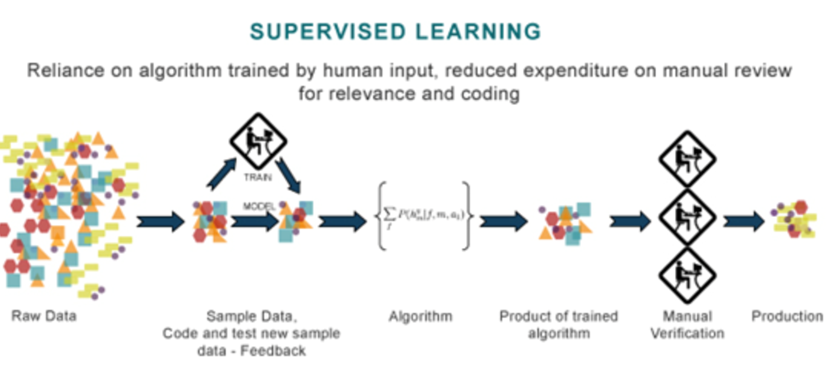
• Supervised Learning: Trained with labeled data (like example documents) to predict outcomes.
Predictive coding
Amazon recommendations for "more like this"
Email spam filters - "is this spam or not spam"
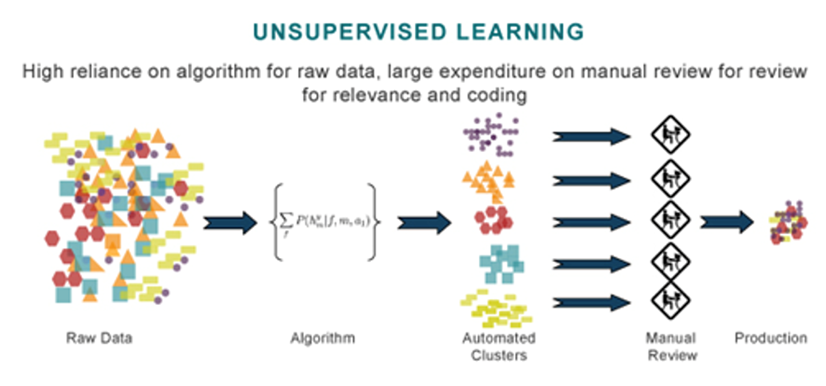
• Unsupervised Learning: Analyzes unlabeled data to find hidden patterns, useful in fraud detection and concept clustering.
Brainspace cluster wheel and other data visualization
Detecting fake likes and bots on social media
General Fraud Anomaly detection
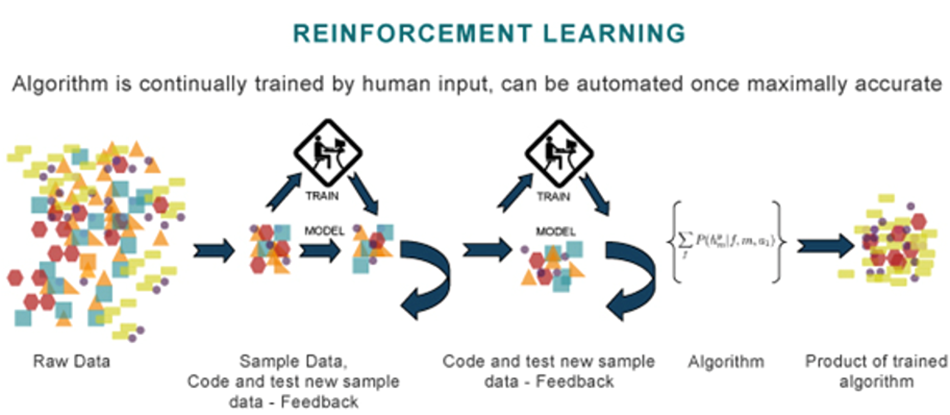
•Reinforcement Learning: Learns through trial and error, often used in tools that prioritize relevant documents in eDiscovery.
Continual Active Learning and TAR 2.0
Netflix Queue and Amazon Suggested products - uses supervised machine learning to make recommendations based on past viewing habits ⁃
YouTube recommendations - the platform makes recommendations like Netflix based on past viewing patterns and subscriptions.
Diving Deeper: Flavors of Deep Learning Transforming Law
Deep learning is like the prior forms of machine learning but on steroids. With these models much larger data sets and systems that are both more robust in computational power and designed to mimic a human Brian. Also known as neural networks, deep learning takes advantage of layers of nodes, similar to neurons in the human brain. Each layer learns from the layer before it, and the deep from deep learning refers to how many layers deep this process extends.

Natural Language Processing (NLP)
Deep learning has helped machines better understand and generate human language. With NLP, AI can speak like a human. NLP can understand the context and meaning beyond merely the words and phrases on a page of programmed grammar rules.
• Role in Legal: NLP enables AI to process and understand human language, extracting key insights from contracts, case law, and client documents.
• Applications in Legal Tech:
Document Summarization: Condenses lengthy documents into key points.
Text Analytics: Identifies themes, patterns, and trends in text data.
Entity Recognition: Pinpoints people, organizations, and key dates in large datasets.
Computer Vision in Legal AI
Deep learning is a master at processing and classifying images, effectively helping machines “see” like a human. While AI and machine learning make computers “think” like a human, “computer vision” makes computers “see” and interpret like a human. Now more than ever being able to see what is in your data set can be critical to a case.
• Purpose: Allows AI to "see" images, useful for identifying critical visual data in cases involving social media or photo evidence.
• Legal Applications:
Image Classification: Organizes evidence based on visual content.
Object Detection: Identifies specific items, such as logos or trademarks, within images.
Facial Recognition: Used in fraud detection and surveillance.
Preparing for an AI-Driven Future in Law
Artificial Intelligence offers transformative potential for the legal industry—from eDiscovery and document review to client management and risk prediction. While AGI and ASI are still hypothetical, the tools we have today (ANI) are already changing the game. Legal professionals who embrace and understand AI will be better equipped for the future, where human insight and AI efficiency go hand-in-hand.
What Legal Professionals Can Do Now:
• Stay Educated: Familiarize yourself with AI basics and keep up with developments.
• Advocate for Responsible Use: Push for transparency, fairness, and accountability in AI tools used in law.
• Experiment with AI Tools: Understand the strengths and limitations by integrating AI tools in non-critical workflows.
Future Outlook:
• Growth of AI in Law: As AI advances, expect more sophisticated tools for case management, predictive analytics, and more.
• Human-AI Collaboration: While AI handles repetitive tasks, legal expertise remains essential for context, strategy, and ethical judgment.
Conclusion: AI as an Ally in Law
By staying informed and engaging with AI responsibly, the legal profession can harness AI’s power while safeguarding ethical and legal standards. The future is here; it’s time for the legal field to lean in, learn, and leverage the best of AI.
#GenerativeAI
#FutureandEmergingTechnologies
#100Level
#Just-in-Time
#ArtificialIntelligence
#BlogPost