
Large Language Models, the Legal AI Tipping Point
A Large Language Model (LLM) is a powerful AI system trained on vast amounts of text data to understand and generate human-like language. LLMS are often used for tasks like drafting, summarization, and answering questions. They are the digital brain behind tools like ChatGPT. It’s like a 24/7 junior associate for drafting, summarizing, and answering questions without coffee breaks (or billable hours).
What Are LLMs At a Glance?
- LLMs are massive AI models trained on extensive text data to understand and generate human-like text.
- An LLM AI system uses this learned information to predict and generate coherent responses by selecting the most likely "next word" in a sentence, one step at a time.
Examples
-Popular LLMs include OpenAI’s GPT series, Google’s Bard, and Meta’s LLaMA, each with unique strengths for various information-intensive tasks.
Why LLMs Matter for Legal
- Drafting Documents: LLMs can streamline the drafting of contracts, briefs, and legal memos.
- Case Analysis: They assist in analyzing case law and producing summaries, accelerating legal research.
- Client Service Automation: Automate responses for client inquiries, improving response times and efficiency.
- LLM- Powered eDiscovery Search: early LLMs like BERT and more recent ones like GPT are supercharging eDiscovery search
Potential Risks
- Lack of True Understanding: LLMs don’t actually “know” or “reason”; they predict text based on probability, which can lead to confident-sounding inaccuracies.
- Ethics and Bias: Without proper checks, LLMs may produce biased or misleading information, a critical consideration in high-stakes legal contexts.
Generative AI: The New Legal AI Frontier
If artificial intelligence is a machine that can think like a human, generative AI takes this a step further. GAI can create like a human. Generative AI is artificial intelligence that can generate new content, such as text, images, audio, or video based on simple human prompts and the data they were trained on.
The AI Innovation of LLMs is the foundation all current Generative AI is based.
More recent types of Generative AI do not need any technical skill to deploy and have widely been adopted. Rather than simply identifying patterns in a data set, Generative AI models can generate statistically probable outputs based on human generated prompts.
Stated simply, models learn from a data set like Wikipedia or even Reddit and try to guess the next word in a manner that allows them to create new content in a variety of formats.
The Generative AI Boom: From Art to Legal Briefs
Unlike prior machine learning and even natural language processing-based technologies that detect and represent patterns within a data set or execute a proscribed task based on user input, Generative AI creates something that did not previously exist. This opens a world of possibility for outputs from limericks to substantive briefs, cheeky doodles to award winning artistic masterpieces.
What Is Generative AI at a Glance?
Generative Artificial Intelligence (GAI) refers to a type of artificial intelligence that can generate new content, such as text, images, audio, or video based on simple human prompts. Prompt Engineering is the art and science of crafting directions for GAI to generate the output you want.
- Generative AI can create new content—text, images, audio—based on human prompts, taking AI’s role from automation to content generation.
- Examples: Tools like ChatGPT for drafting and DALLE for images are prime examples of generative AI at work.
Flavors of GAI
- Text Generation: AI whipping up text like it's going out of style—summaries, translations, or even witty virtual assistant chatter. Think ChatGPT and its word wizardry.
- Image Generation: AI transforming prompts into images from scratch or giving existing ones a glow-up. Whether it’s photorealistic or fantasy, tools like LENSA and DALLE-2 deliver.
- Audio Generation: AI generating music or eerily human-sounding speech to bring multimedia projects to life—Lyrebird and Descript are leading the sound revolution.
- Video Generation: AI turning text prompts into custom videos, from animated messages to full-blown deepfakes. This tech is shaping the future of personalized video.
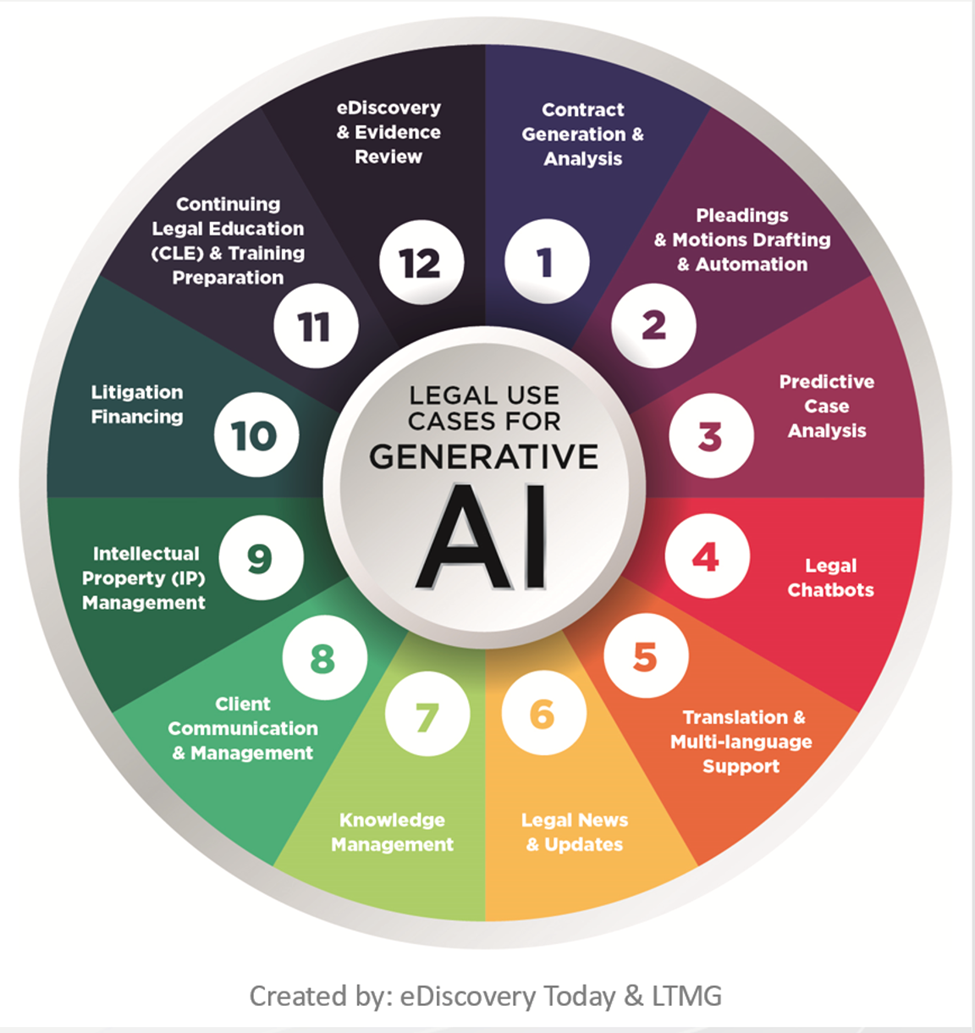
Why Generative AI Matters for Legal:
- Drafting Documents: Automates drafting of contracts, legal briefs, and other documents.
- Research Summaries: Generates summaries from vast legal databases.
- First Pass Review: Generative Ai is being used to replicate human coding decisions in eDiscovery
- eDiscovery Search and Summarization: GAI offers free-form text field data searching and content summarization.
- Potential Risks:
- Hallucinations: Generative AI may produce inaccurate or “hallucinated” information, requiring human oversight.
- Intellectual Property Issues: Ownership and copyright questions arise over AI-generated content.
- Privilege: If used open source where privilege data trains a model, could vitiate privilege

Potential Legal Headaches with Legal AI
As with every technological advancement, bad actors will find a way to misuses and abuse the tools. Generative AI is no different. What happens if bad actors go rogue with this powerful tech?
Deepfakes and the Legal Challenges of Verification
The ability to generate highly convincing versions of real humans doing and saying things poses a big problem. Deepfakes are videos or audio recordings that are designed to deceive people into thinking they are genuine. Consumer grade GAI makes this very easy to do.
Deepfake Technology
- Definition: Uses AI to create convincing, altered video or audio that mimics real people.
- Risks in Legal: Deepfakes could manipulate evidence, creating verification challenges in eDiscovery and litigation.
Legal Concerns with Deepfakes:
- Evidentiary Authentication: Legal professionals need advanced tools to detect deepfakes.
- Intellectual Property: Unauthorized use of likenesses raises questions around privacy and copyright.
Preventative Measures:
- Digital Forensics: Experts use metadata, voice patterns, and image analysis to verify authenticity.
- Legislation and Policy: Ongoing development of policies to combat deepfake misuse in courtrooms and beyond.
Ethical and Legal Implications of Advanced AI
It is not merely bad guys who raise concerns about legal issues with the surge of the GAI tsunami. For legal practice, there are some foundational concerns to be aware of when integrating GAI into law firms or legal services.
Key Concerns:
- Bias in AI: AI models trained on biased data can inadvertently perpetuate discrimination.
- Hallucinations: GAI, like ChatGPT, is like an over-eager first year and will sometimes answer what the prompt engineer wants to hear, not accurate response. (For the love of all this is holy check any citations it ever gives you, just ask the attorney in the Avianca Case).
- Transparency: As AI grows more complex, ensuring transparency and explainability in AI decision-making becomes critical.
- Accountability: Determining liability in AI-driven decisions poses challenges for legal systems.
Regulations in Development:
• EU AI Act: Establishes global standards for AI accountability, focusing on high-risk applications.
• GDPR & Data Privacy: Regulates personal data use in AI across the EU, with implications for legal and data practices.
• U.S. AI Bill of Rights: Outlines protections for data privacy, transparency, and fairness in AI applications.
• AI Liability Directive (EU): Focuses on liability for AI-related harms, assigning responsibility to developers and deployers.
• NIST AI Risk Management Framework: Provides a voluntary framework to help organizations manage AI risks securely.
• China’s AI Security Guidelines: Includes data privacy and algorithmic transparency requirements under China’s Personal Information Protection Law (PIPL).
• FTC Guidance on AI and Algorithms: Advises U.S. companies on maintaining transparency, fairness, and reducing bias in AI systems.
Embrace the Frontier of Legal AI
So, here we are at the edge of a legal tech revolution. Generative AI isn’t just a buzzword anymore—it’s a fundamental shift in how we approach, analyze, and produce legal work. With LLMs as our tireless junior associates and Generative AI transforming everything from document drafting to deepfake detection, we’re entering a new era where efficiency, speed, and creativity are supercharged. But like any powerful tool, GAI comes with its risks: hallucinations, deepfakes, and biases can create more chaos than clarity if we’re not careful.
For legal professionals, it’s about using GAI as an ally while staying vigilant about the accuracy, ethics, and potential legal pitfalls. The best strategy? Embrace the tech, stay curious, and build a toolkit of critical thinking, verification processes, and responsible deployment. In the hands of savvy lawyers, GAI isn’t a threat to the legal profession—it’s an upgrade.